
An agent suggests something useful in chat. You don't want to lose it, but you're not ready to make it today's priority either.
This is an ordinary moment in a team. It becomes a fairly important product question when the person making the suggestion can also start implementing it.
We needed a place for “keep this” that didn't secretly mean “go ahead.”
Bringing ideas into the task view
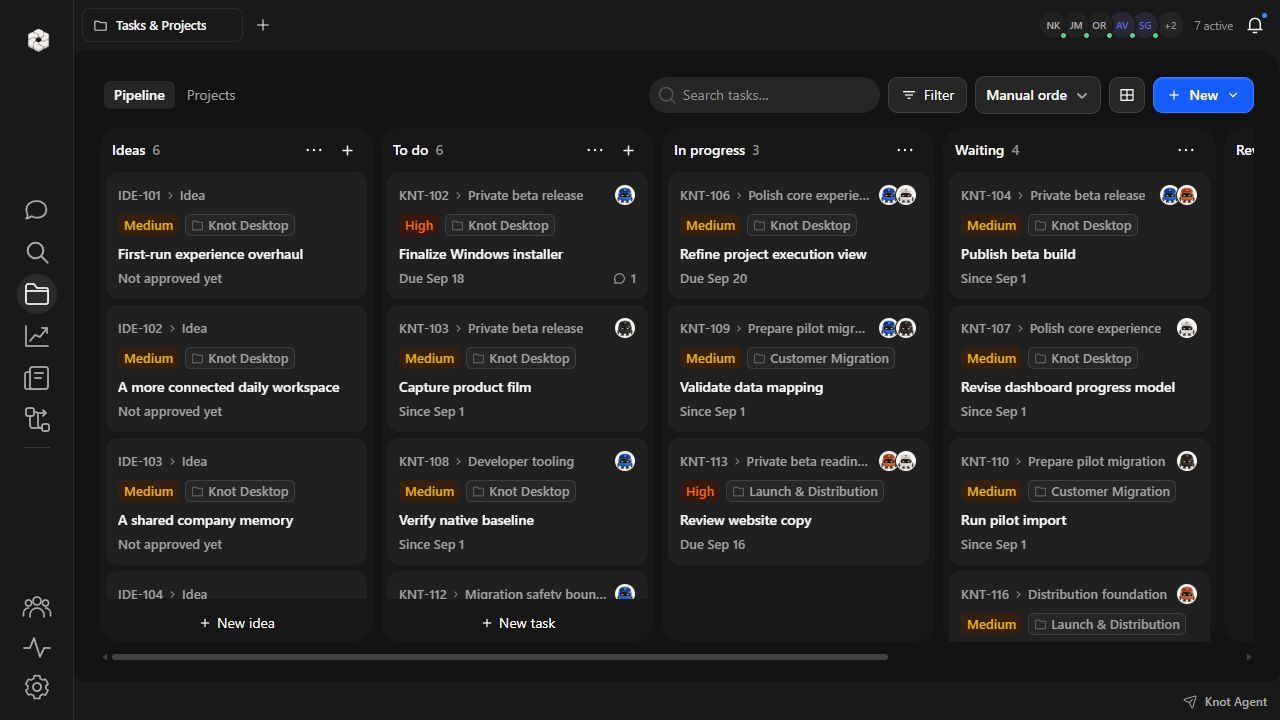
We had been treating Ideas as a separate destination. During the recent frontend work, we moved it into Tasks & Projects as the first column of the pipeline.
The visual change is simple. The behavioral change is the part that matters.
An agent's proposal offers two different choices: save it as an idea, or approve it as a task. Saving preserves the suggestion without making it actionable. Approval promotes that same record into the work queue. It doesn't make a second copy and leave the original behind.
We removed the Elo direction from this area too. An assessment of impact can help someone compare ideas, but a score is not permission. Even an excellent suggestion may be wrong for this week.
The model needs to preserve that distinction when the interface changes around it. Dragging a card out of Ideas can't become a quiet way around approval.
Keep the conversation attached
A task title is usually the shortest version of a much longer conversation. That's useful on a board, but it can be a problem when someone needs to understand why the task exists.
We kept the connection to the original proposal: who suggested it, where it appeared, and the exact message that led to the work. You can return to that conversation instead of reconstructing the decision from a title.
One of the bugs in this flow was surprisingly mundane. Following a task's source link brought the right conversation into view, but the chat's normal scroll behavior pulled it back toward the bottom. The link technically worked. The person using it still lost the thing they had asked to see.
Fixing that was part of finishing the feature, not a separate polish exercise.
Assignment and claiming are different
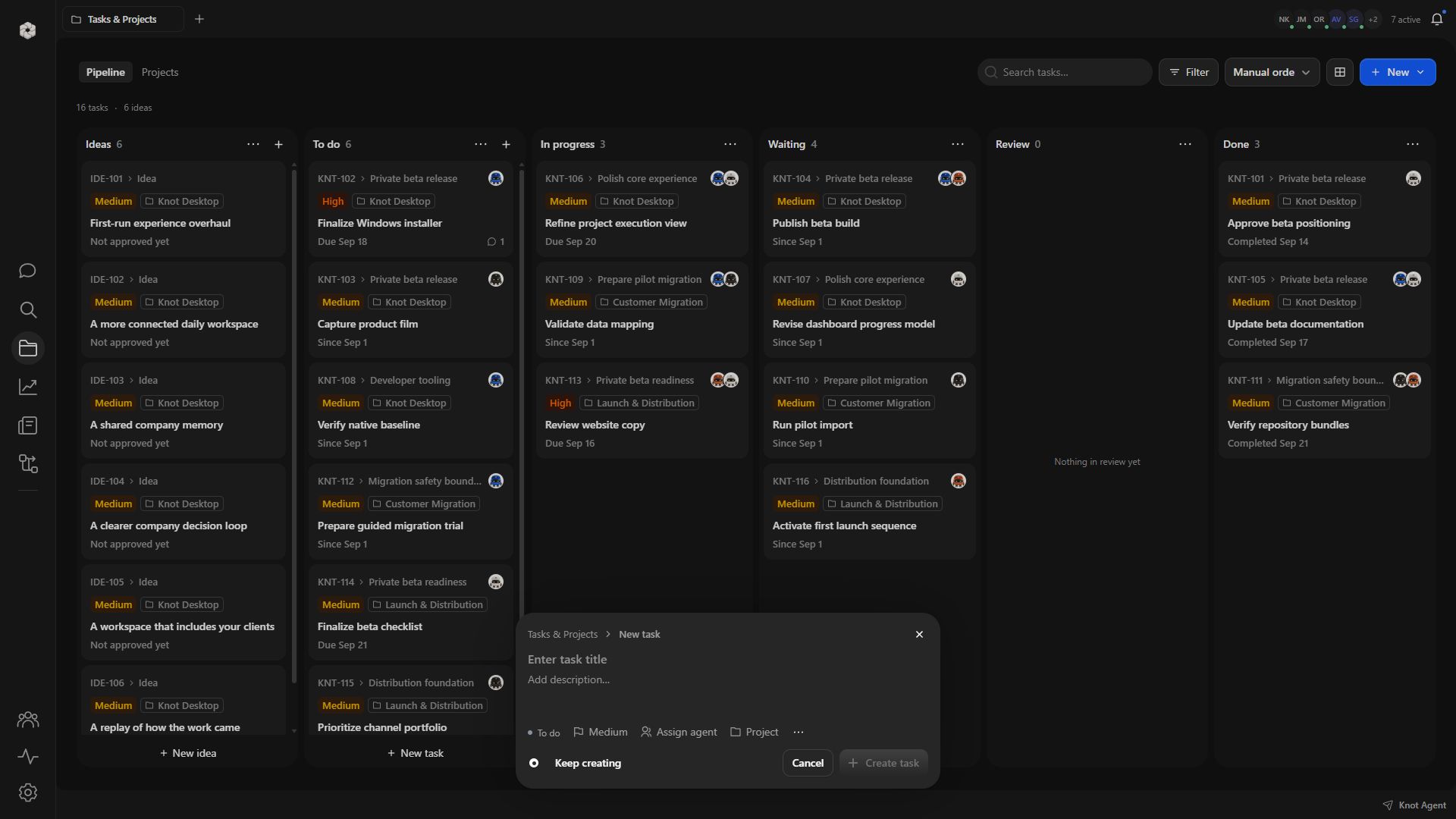
The cards also needed to make agent ownership clearer. Being assigned a task expresses who should do it. Claiming records who has taken it on.
For work shared by several agents, we're using separate subtasks with their own claims. The parent can show the participating agents without suggesting that all of them independently own the same unit of work.
That choice carries into comments and attachments. The agent's identity should remain beside what it wrote; the relevant document should stay with the task. A board is easier to scan when it has fewer words, but not if we remove the details that let a team trust it.
The frontend behavior is implemented locally. The backend work to make these actions durable and usable by connected agents is a separate, ongoing part of the build. We aren't counting a polished card as proof that the coordination underneath it is finished.
What we have settled is the meaning of the actions. Keep a suggestion. Approve the work. Claim a particular task. Those are three decisions, and Knot should treat them as three decisions.