
A task can appear in several places without becoming several tasks.
You might find it while reading a conversation, open it inside a project and later look for it in your own task list. Each view answers a different question. The conversation explains why the work matters. The project shows where it belongs. Your list helps you decide what needs attention next.
The owner and due date should not depend on which route you took to get there.
In September, we paused broader workspace refinement to consolidate the people, projects and tasks used across the existing views. The immediate goal was not a new dashboard. It was to make the workspace describe the same work before asking it to describe that work more beautifully.
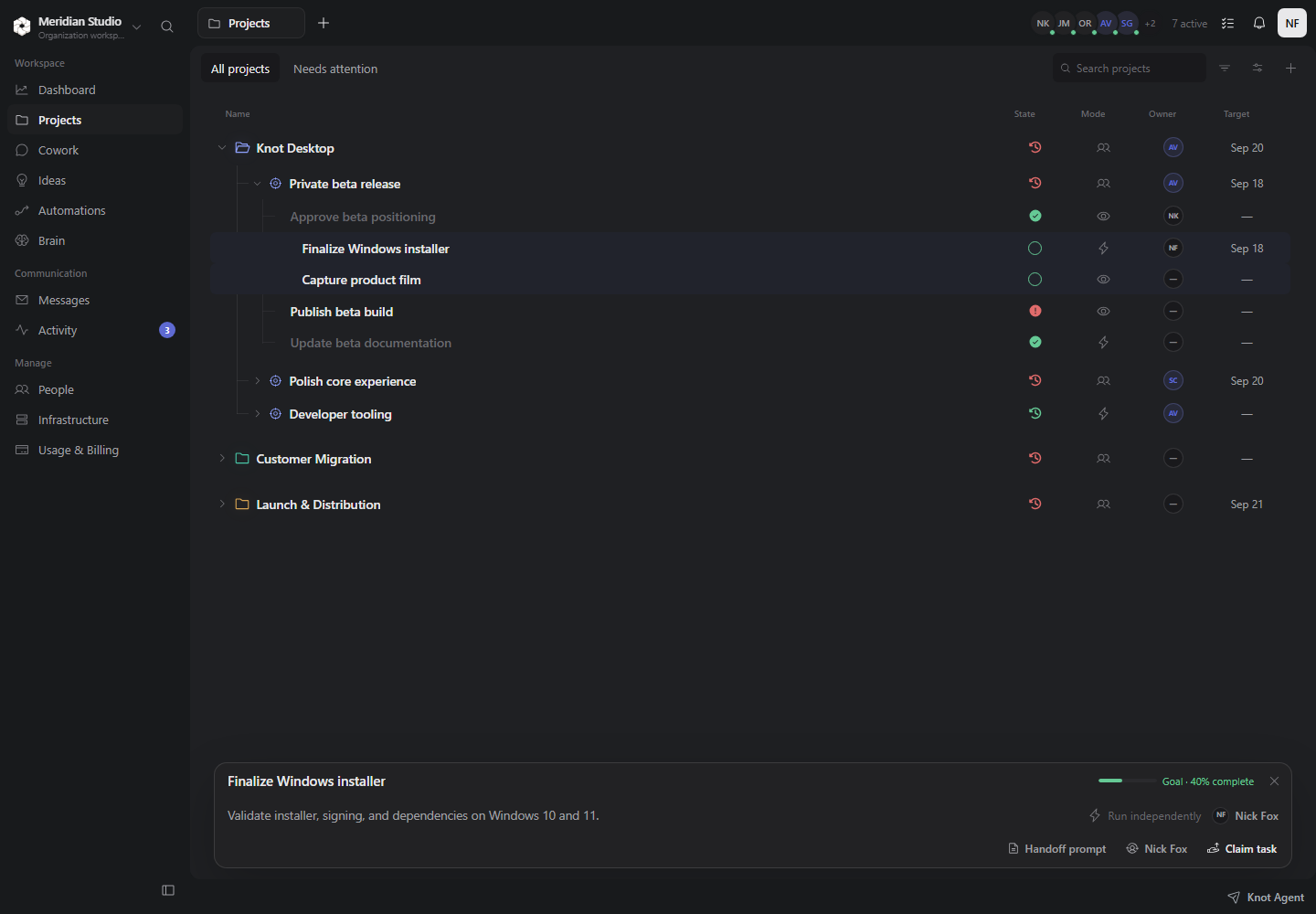
The cost of convincing individual screens
Example data makes a screen easier to design. A project view needs projects. A task menu needs tasks. A conversation needs people discussing something. It is possible to make each of them look coherent while the workspace as a whole still tells several incompatible stories.
The consequences are subtle at first. A person appears in one assignment menu but not the directory. A project name differs across two panels. A task has an owner in the conversation and none in its detail view. None of these problems is solved by better spacing around the row.
The shared-facts pass treated identity as something the views refer to, rather than something each view invents. They could keep different layouts and show different amounts of detail. The underlying people, projects and tasks needed to agree.
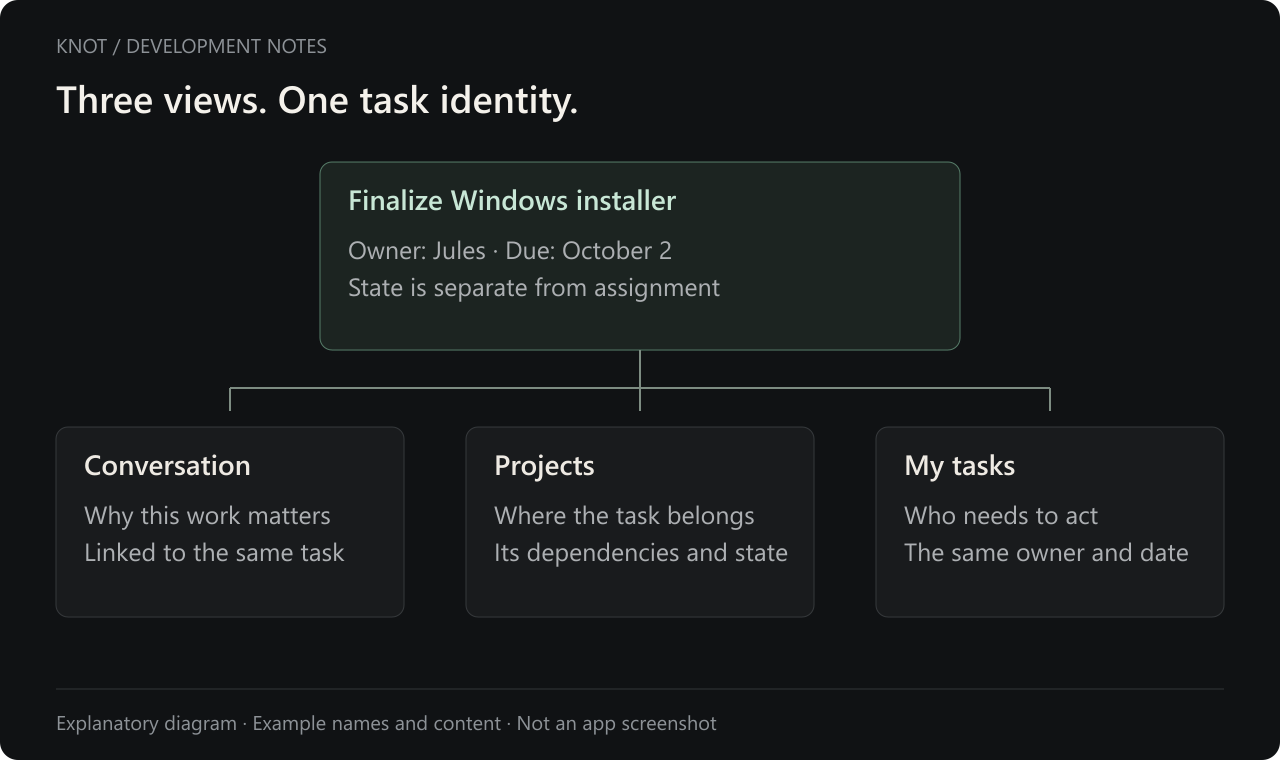
That is not the same as making every screen look alike. Repeating a complete project table beside every conversation would preserve the data while making the product harder to use. A compact reference can expose the same task with less information, provided opening it leads back to the right record.
Follow a change through the workspace
One useful test scenario was deliberately ordinary. Open an installer task in Cowork, assign it to Jules and give it an October 2 deadline. Then move to Projects, select Jules's task list and find the same assignment. Finally, move to Messages and check that the task still belongs to the same person with the same date.
The test source describes that path within one application window. It is a specific consistency check, not proof that two devices have synchronized or that the task was stored by a service. Even that local distinction matters: if the view changes erase the assignment, a person cannot reason about the workspace they are already using.
There was another boundary to preserve. An assignment change is not a work result. It can change who is responsible and when the team expects an answer. It should not increase the number of completed tasks.
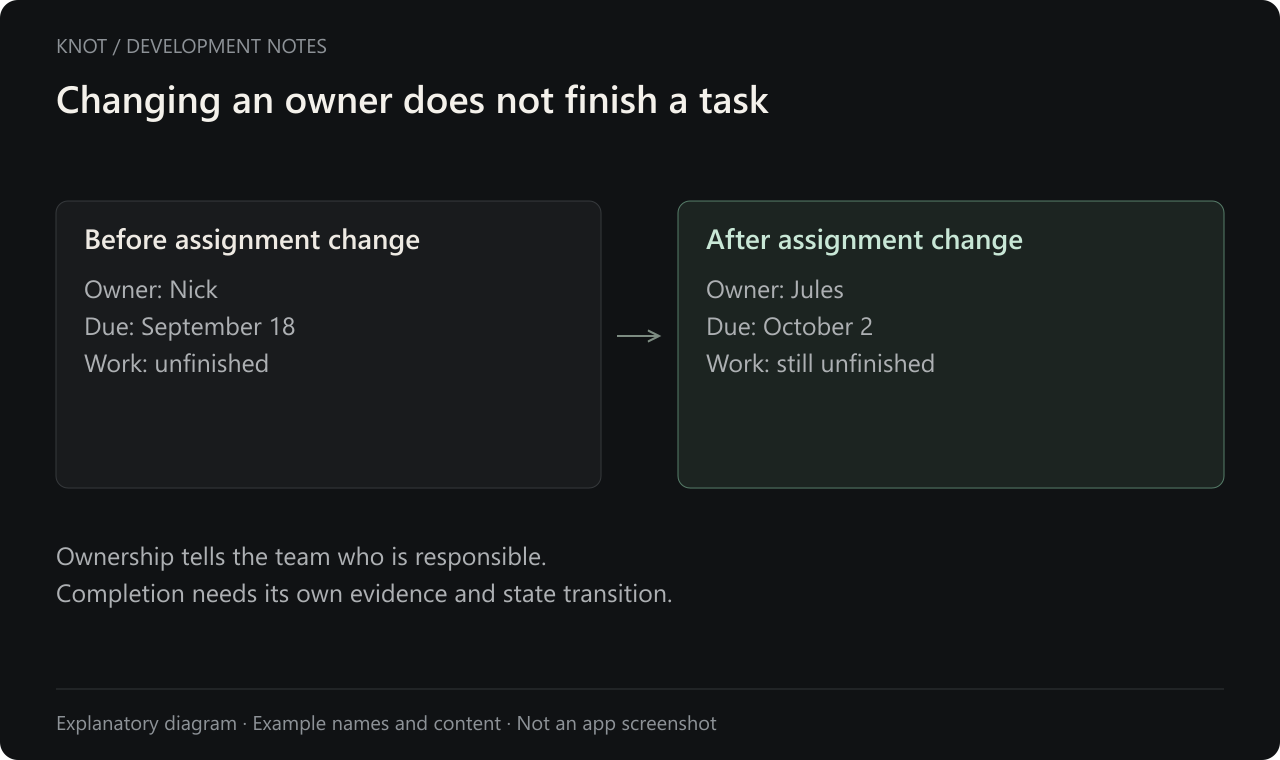
The same applies to personal triage. Clearing something from an attention queue is not evidence that the underlying project task is finished. Those actions need different meanings even when both make a screen look tidier.
Consistency does not require identical totals
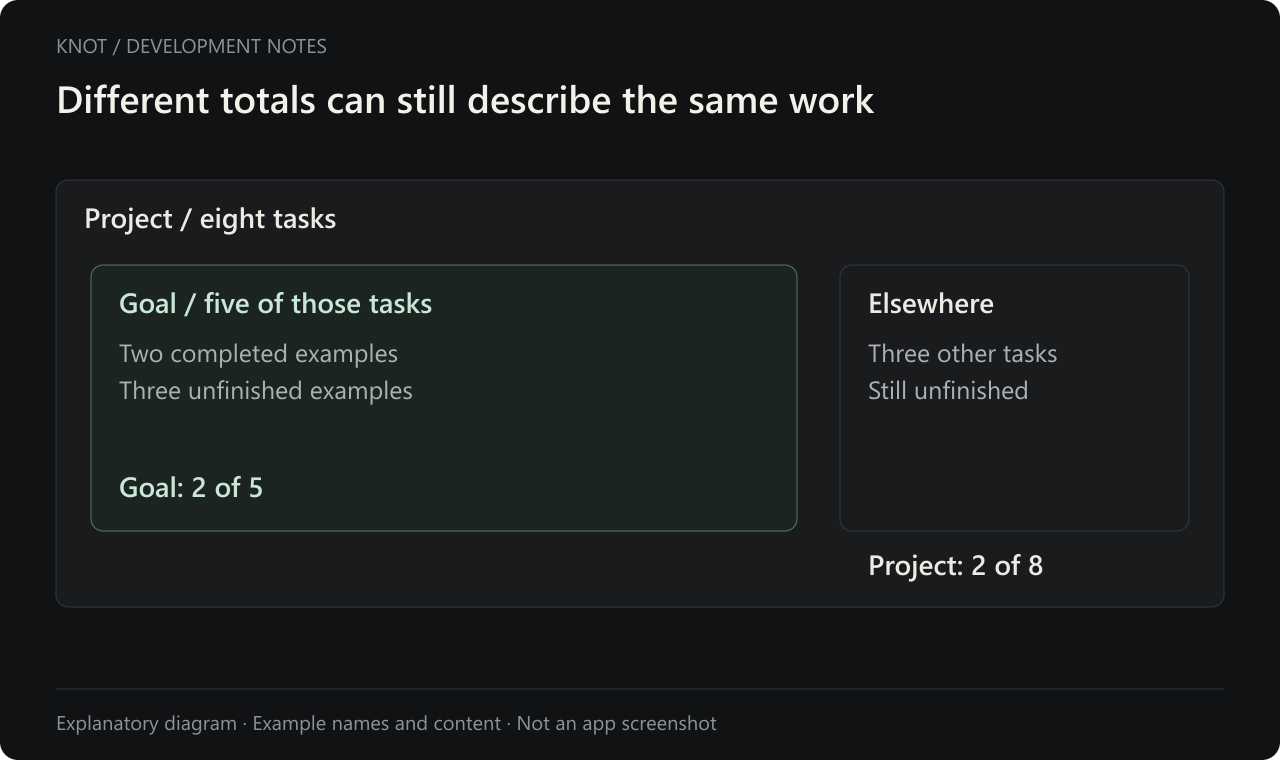
A goal can show two completed tasks out of five while its project shows two out of eight. That is not necessarily a contradiction. The goal is a subset; the project includes additional work.
The important questions are what is being counted and which records belong to that scope. Matching the visible numbers by copying one total into both places would conceal the relationship rather than fix it.
A current snapshot has another limit: it cannot explain how progress changed over time without dated events. Consolidating the task catalog does not, by itself, create a history suitable for a trend chart. That would need its own evidence, rather than a plausible line drawn from today's total.
A foundation, not a synchronization claim
This stage consolidated local presentation records while preserving the existing shell and layouts. It did not connect identity, authorization, transport or agent execution, and it was not acceptance of a new Operations design.
Those limits do not make the work cosmetic. A team needs to trust that opening a task from another place does not change what that task means. Shared records give each view a common starting point, and give later integration something more precise to preserve.
The outcome we want is unremarkable in the best sense. You change an assignment, follow the work into another view and find the same task waiting there. You can spend your attention on the work instead of reconciling the product.