
A test result can be correct and still answer a smaller question than the one you care about.
A payment contract can pass without anyone making a real payment. A sign-in journey can work against a local authentication service without proving that a customer can enter the hosted app. A build can start inside a container while the complete product journey remains unfinished.
During the work to bring Knot's frontend and backend together, those distinctions became part of the development record. We needed to know exactly what each green result allowed us to conclude.
First, make sure the test is in the right environment
At the September integration checkpoint, a focused backend contract suite passed while the broader repository test run still had substantial failures. Treating either result as the whole story would have been misleading.
Some failures came from server tests running in a simulated browser environment. Others involved database prerequisites, mocks or runtime behavior. They did not all have the same cause, and fixing the test environment would not fix every remaining failure.
We separated the Node and browser test environments, keeping browser setup out of server suites. That made the checks more faithful to the code they exercised.
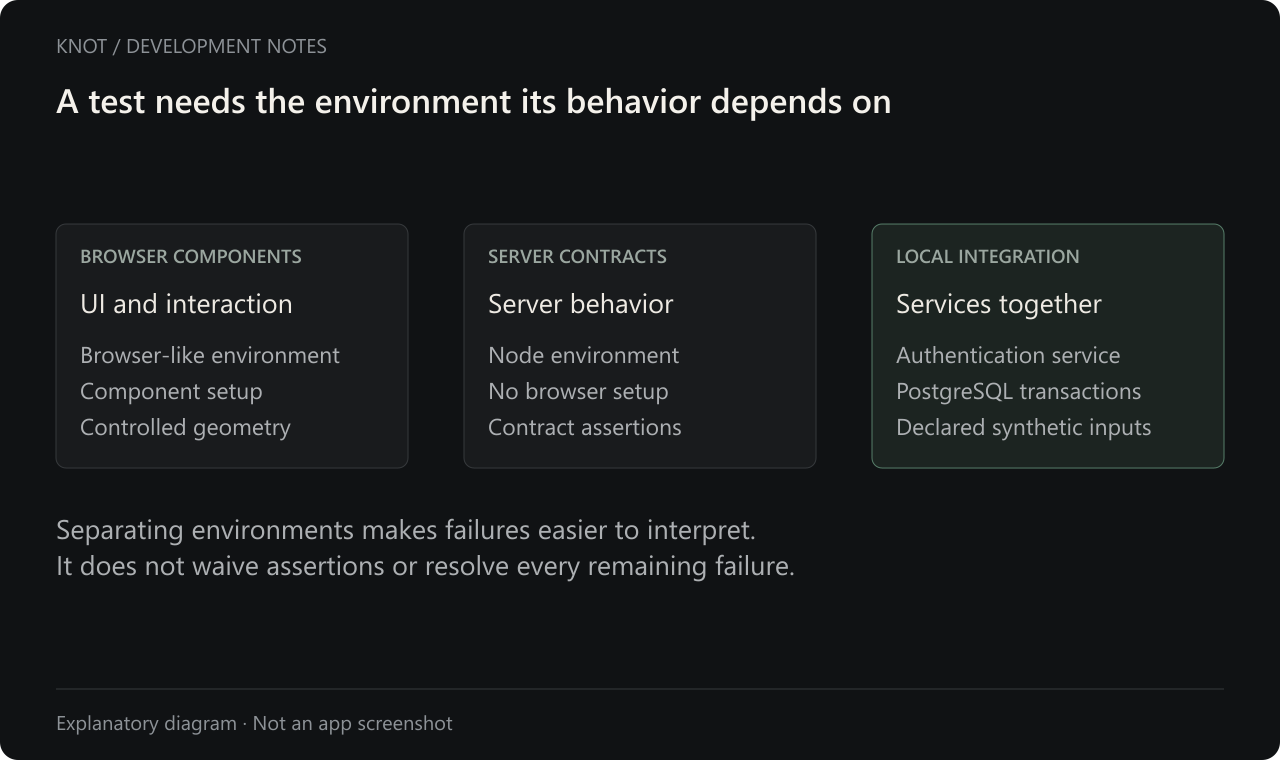
This is an important distinction from weakening a test. An assertion about server behavior should still hold. It should be evaluated in the environment where that behavior is supposed to run.
The correction improved the evidence. It did not turn the remaining broad-suite failures into passes, and the September record retained those failures. A focused green suite remained a focused green suite.
Write down what “real” means
On October 5, one local qualification exercised six sign-in and session journeys against actual authentication and PostgreSQL services. The cases included refresh and logout behavior, restart behavior and access that must remain denied.
That was stronger evidence than a mocked authentication response. It still had a boundary: external provider responses were synthetic, and the hosted frontend journey was not part of the run.
Later that day, the work progressed beyond that first checkpoint. A combined local check of authentication and payment handling passed twenty cases. Actual authentication and database transactions were involved; payment and provider inputs remained synthetic.
That distinction belongs beside the result, not buried in a footnote.
| October 5 record | Reported result | What it exercised | What it did not establish |
|---|---|---|---|
| Sign-in/session qualification | 6 of 6 | Local authentication and database journeys | Hosted frontend or real external sign-in |
| Later joined qualification | 20 of 20 | Local authentication and payment handling | Real payment or customer activation |
| Later status-image qualification | 23 of 23 | A packaged process and its container behavior | The complete hosted customer journey |
Results reported by the preserved development checkpoints. This essay did not rerun those tests. The rows are separate bodies of evidence, not a cumulative launch score.
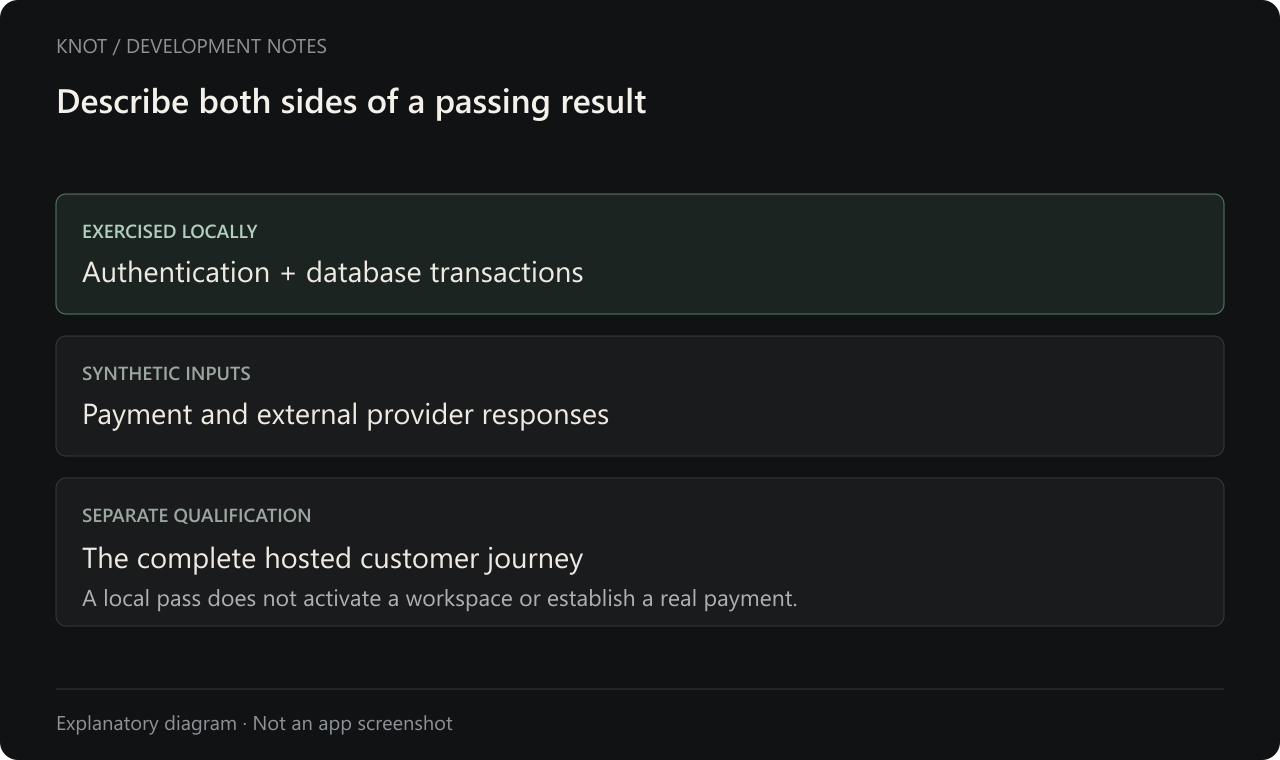
A useful report states both sides. “Local authentication passed with synthetic provider inputs” is more informative than either “authentication works” or “it's all mocked.” It tells the next person what they can build on and what they still need to test.
Test the artifact you intend to run
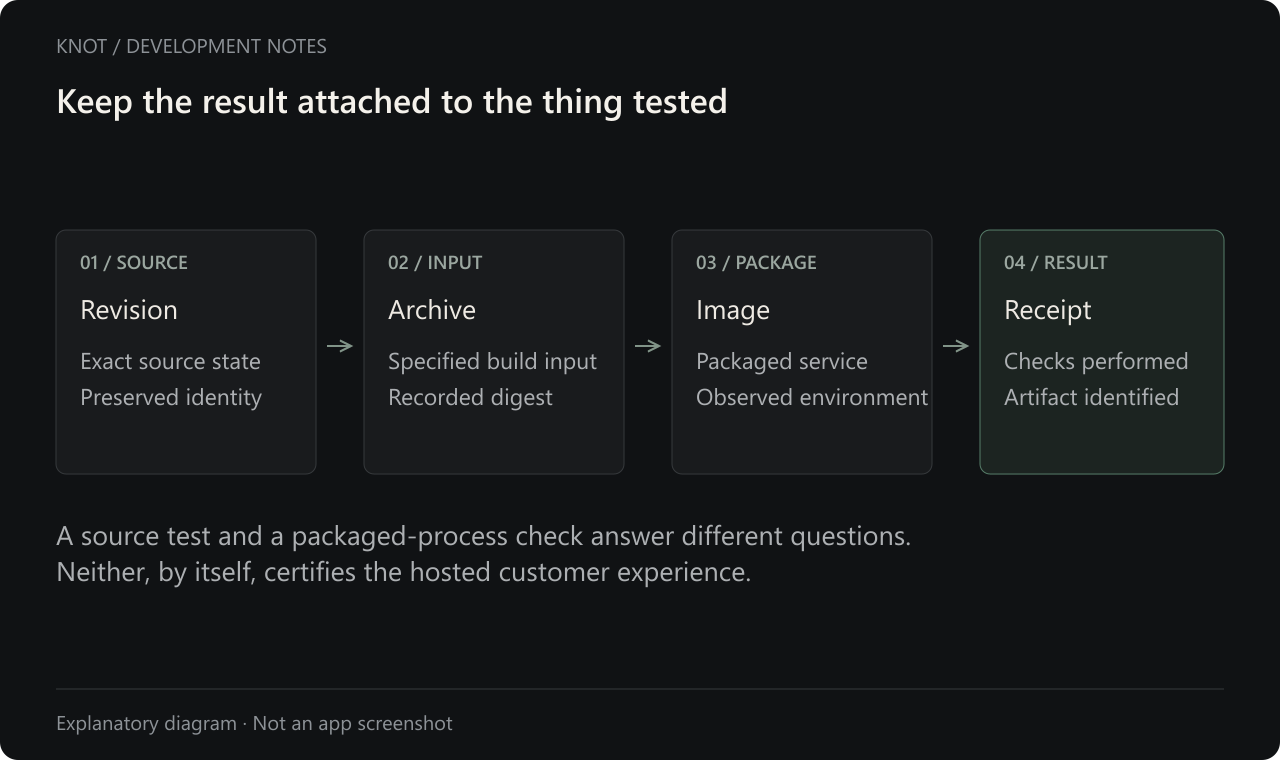
There was a separate question about the packaged service. Passing source tests does not identify the exact bundle that will later be started.
The container work tied checks to a particular source archive and packaged image. It tested such things as process behavior and the files present in that environment. The record also kept failures encountered while preparing those checks.
One preparation invocation omitted an explicit source timestamp. Correcting the invocation addressed that problem; it did not require claiming a Dockerfile fix. Another check had an overly narrow assumption about the image environment. Its correction was scoped to the expected entry, rather than allowing any difference to pass.
Those distinctions are easy to lose in a summary that says the container is now green. Keeping them makes the result easier to reproduce and review.
Keep the remaining question visible
These checks reduced uncertainty about particular parts of Knot. They did not remove the need to qualify the complete customer path: entering the product, reaching the intended workspace and using the permitted features through the hosted interface.
By the end of October 5, the record included further local billing checks, while leaving workspace activation and the hosted journey as separate work. Reporting that boundary did not diminish the progress. It kept the next decision from depending on evidence those checks had not established.
We want the development record to be useful after the excitement of a passing run has worn off. That means preserving failed attempts, naming synthetic inputs, identifying the artifact and dating each result.
A test should let us make a more precise decision. When it becomes a general statement that the product is ready, we have asked it to prove too much.