
A team changes a release decision in a private discussion. The agent writing the announcement needs to know what changed. It does not necessarily need the discussion that led to it.
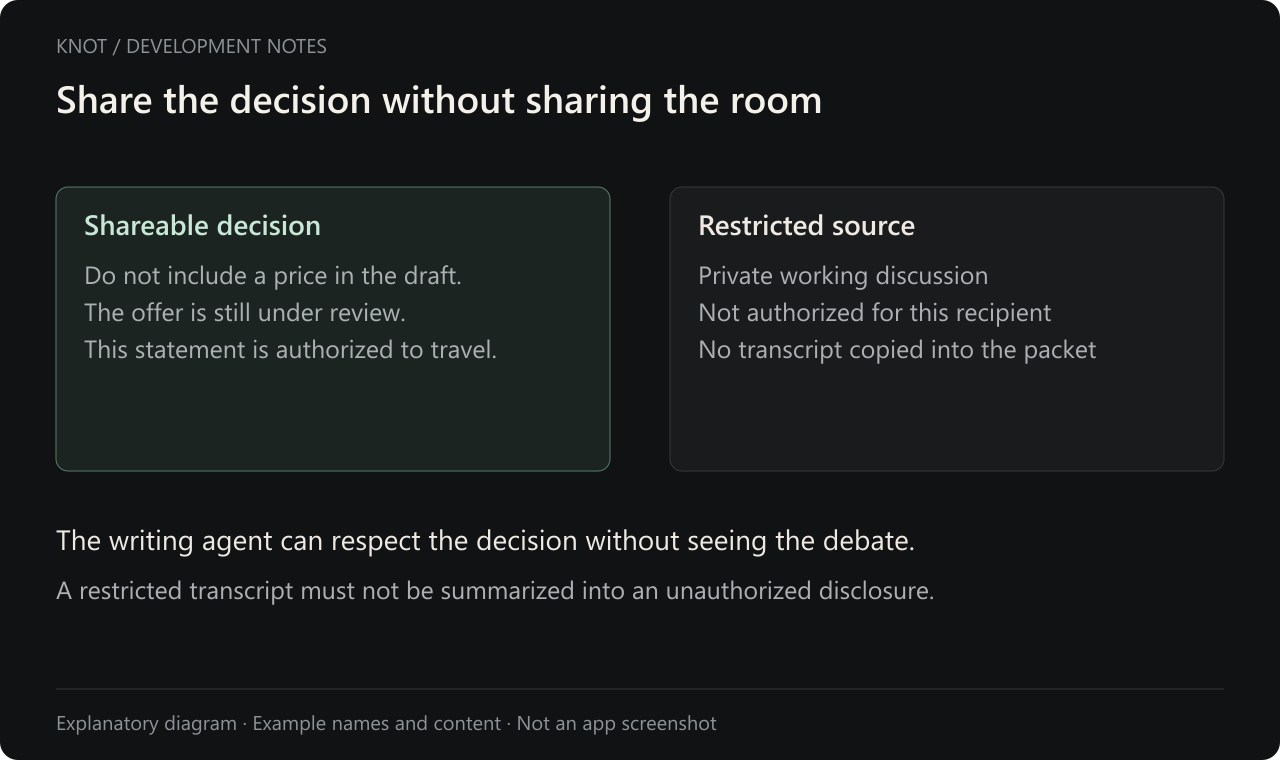
For example, a team might agree not to mention a price while the offer is under review. That instruction can be useful to the writing agent without exposing private drafts, discarded assumptions or the conversation behind the decision. The instruction must itself be authorized to share. Calling a private transcript a summary does not remove its boundary.
This is a practical question for multiplayer AI. Information has to travel between people and their agents, but the ability to coordinate cannot depend on every room becoming available to every participant.
Our August work examined one narrow part of that problem: when a system rebuilds the history of a task, which material may become input to the receiving worker?
Keeping a record is a different job from preparing context
A historical record answers questions about what happened. It can help explain the order of changes and the material a task depended on. A context packet has a different job: provide the information this particular recipient is permitted to use for this particular work.
Those jobs overlap, but treating them as identical would make a dangerous shortcut. If the context builder takes everything it can find in history, the act of retaining information becomes permission to disclose it again.
The August proof deliberately included both allowed and denied source material in the replayed history. The resulting context packet contained only the allowed set. The denied source remained part of the proof's historical evidence without becoming input to the recipient.
That was the important distinction. We did not want a passing example in which every available source happened to be shareable. The example needed to contain something that should stay out.
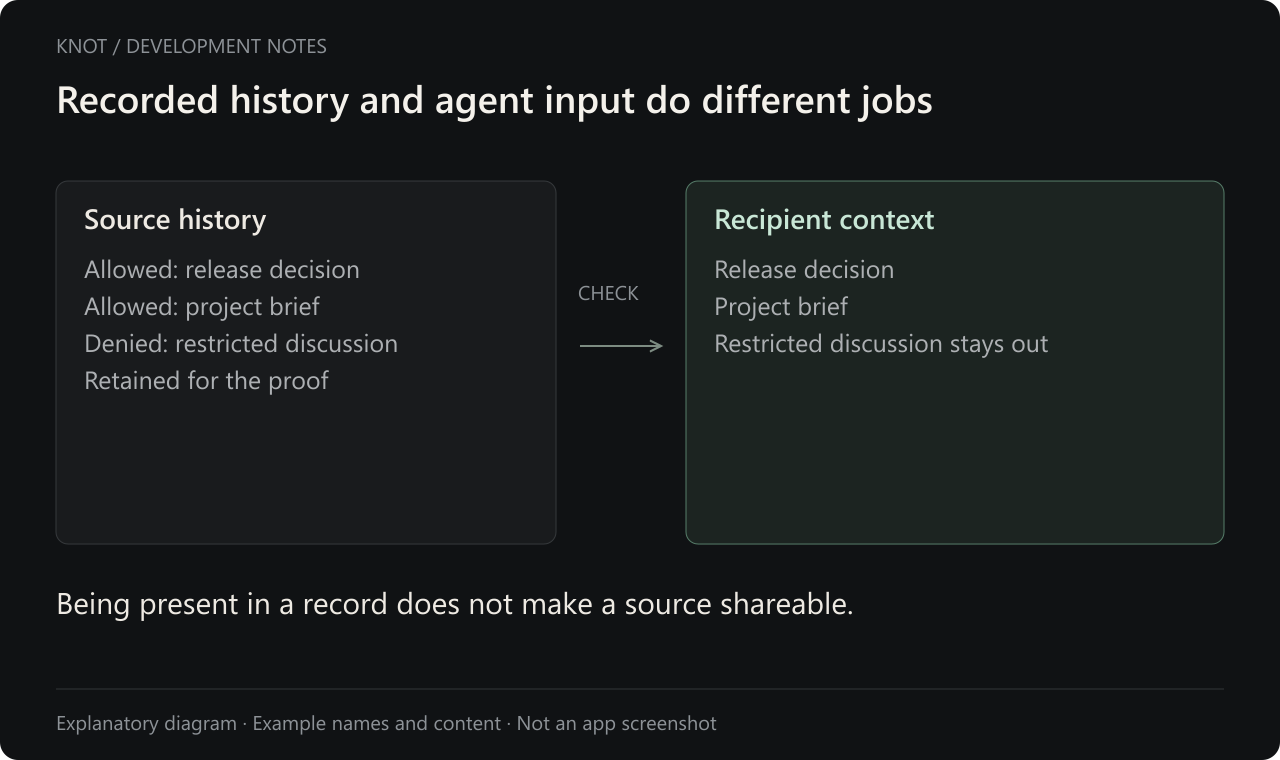
This also changes how we think about relevance. A source can be highly relevant and still be unavailable to a worker. A permission check that asks only whether the material would help answer the question is asking the wrong question.
When required material is unavailable, the system has an incomplete assignment to resolve. It should not infer that a useful answer is permission to include the missing source, or quietly substitute a less constrained description of it.
Permission has a time as well as an audience
Access changes during the life of a project. A person moves to different work. A source is withdrawn. An agent no longer has the same authorization. The original event may still need to exist in the task's history.
If a later context packet simply inherits an earlier delivery decision, the system can preserve access that the organization has already changed.
The August contract therefore considered the receiving worker and its current authorization, along with the task, project and permitted material. The recorded history was an input to that decision, not a replacement for it.
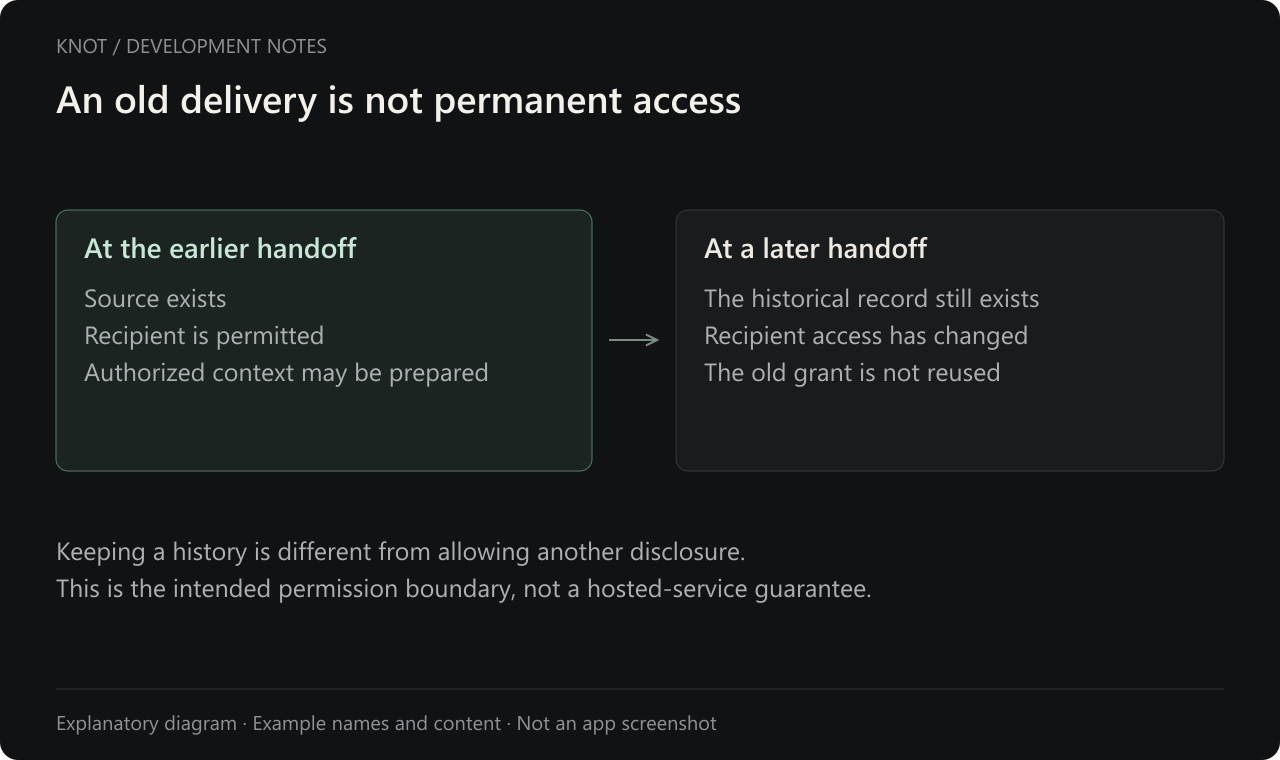
This does not mean a system can make a recipient forget something already disclosed. Preventing a new unauthorized disclosure and recalling information from a previous recipient are different problems. A sensible product explanation should not blur them.
It also means that “keep everyone contextualized” needs a precise meaning. Everyone should be able to receive the updates appropriate to their work and access. It should not mean every agent gets the same company-sized prompt.
A boundary people can reason about
The implementation record was a source-only proof using synthetic material. It did not send a real context packet to a worker, advance a live history cursor or establish a commercial service's privacy guarantees. Those operating paths need separate qualification.
What the proof supplied was a specific relationship to preserve as those paths are connected: reconstructing history must not expand the recipient's access. It is a more useful requirement than a general promise that context is private.
The interface still has work to do around that relationship. A person should be able to understand what they are sharing and where it is going. Missing context should be actionable without exposing the restricted contents in an error message. Changing a source's availability should not require understanding the storage system underneath it.
For the writing-agent example, a good result is quite ordinary. The agent knows not to include the price, understands that a decision remains open and can continue preparing the announcement. The private conversation stays private.
That is the kind of shared awareness worth building: enough information to work together without turning coordination into an invitation to read everything.