
A shared room solved the first problem
The first version of Continuum answered a practical frustration: important work kept disappearing inside separate AI conversations.
We gave the organization one durable room for the updates that changed what other people and models should know. A project could survive the end of a chat. A decision could be found after the person who made it closed a laptop. An AI coworker could report a blocker without relying on a human to paste the report into every related thread.
That changed our expectations quickly. It also exposed the next problem. A room can remember everything and still fail to reach the person doing the work.
Then the room became noisy
Shared context sounds useful until the seventh project reports at once. A company-wide room can become another feed to monitor, another transcript to summarize, and another place where the most recent message pushes the important one out of view.
More context was not the answer. A worker responsible for an interface correction did not need the complete history of a legal filing. A research worker did not need a private operational discussion merely because both belonged to the same organization.
Continuum V2 began with a narrower question: how can an update remain durable at the company level while arriving precisely where it changes the work?
Context needs an address
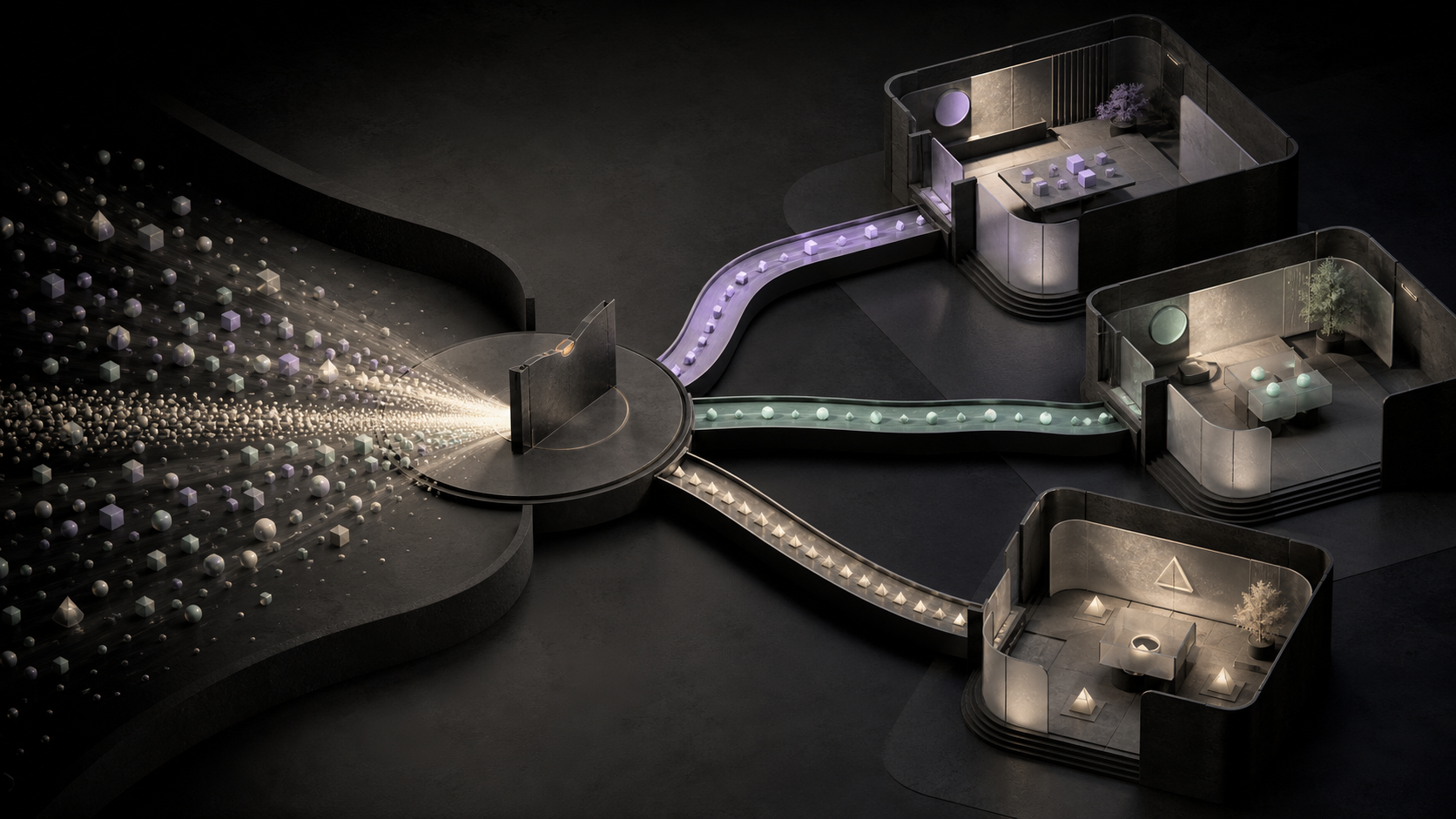
We now think useful shared context has an address. It belongs to an organization, but it can also affect a project, a task, a decision, or a specific set of authorized participants.
The address is not a decorative label. It determines who should receive the update, where the evidence should remain visible, and what the system should refuse to disclose. An update that cannot establish its destination should not be broadcast merely because it might be useful.
This is the shift from shared context to directed attention. The room stays durable. Attention becomes selective.
The room stays durable. Attention becomes selective.
Five guarantees we now expect
First, important organizational updates should be durable. A change should not disappear because a model session ended or an account changed.
Second, delivery should be addressed before it is broad. The system should know which project, task, or authorized audience is affected rather than asking every worker to sort the feed themselves.
Third, causality should remain visible. A person should be able to see which update changed a task, which source supported it, and which decision followed.
Fourth, permission boundaries should fail closed. If the system cannot establish that a worker may receive the context, it should withhold the context and surface the missing decision.
Fifth, human authority should remain explicit. Routing an update does not approve an action, expand a permission, or turn an AI supervisor into the owner of the company.
These are product-level guarantees, not a publication of the private machinery that produces them. They are the behaviors a team should be able to observe and hold us accountable for.
What the internal proof changed
We tested these ideas inside the operating environment our team uses to coordinate its own work. In controlled cases, an update created in one account reached the intended project and task without requiring the receiving worker to read the entire originating conversation.
The retained record made the chain legible: what changed, where it came from, which work it affected, and whether a human decision was still required. Workers outside the authorized scope did not receive the unrelated context.
The important finding was not that messages could move between systems. That part is easy to demonstrate. The useful result was that an update could become organizational memory while attention remained bounded.
Directed attention is not an omniscient prompt
It is tempting to treat this as a context-window problem. Put every document, decision, and conversation into a larger prompt, then let the model decide what matters.
We do not think that is a dependable organizational design. It makes permission difficult to explain, increases the surface for stale or irrelevant information, and hides the selection decision inside a model response.
Continuum should make the boundary visible. A worker receives an authorized update with enough provenance to act or ask for review. It does not inherit the entire private history of the company.
What remains unresolved
An address can become stale. Project membership changes. A task may move. Two updates can conflict. A runtime can disappear after accepting work. A summary can preserve the conclusion while losing the caveat that made the conclusion safe.
Recovery also creates a hard boundary. A system that retries too aggressively can duplicate work or turn a temporary failure into an unauthorized action. A system that stops too early leaves a team with silent unfinished work.
We are still working on how expiration, conflict, liveness, and recovery should appear to the people supervising the system. A coordination protocol is only trustworthy when its failure states are as legible as its success states.
The commercial Auvora boundary
Continuum V2 has been verified inside our internal operating environment. The commercial Auvora implementation remains in development and is not yet generally available.
The commercial product has to make the guarantees understandable without requiring a team to learn our internal operating system. Connections must be verifiable and revocable. Project scope must remain clear. Human approvals must be visible at the moment they matter. Recovery must stop safely.
Until those behaviors pass the complete product and operating gates, the internal proof is evidence for the direction, not a claim of broad availability.
What we are researching next
We want stronger causal receipts that show why an update reached a destination and what changed after it arrived. We are exploring how context should expire, how a newer decision should supersede an older one, and how disagreement should become visible before it becomes duplicated work.
We are also testing the boundary between presence and surveillance. A team needs to know whether a worker is available, blocked, or finished. It does not need an unrestricted view into every intermediate thought or private conversation.
The standard is simple to state and difficult to build: enough shared awareness for the organization to coordinate, with enough restraint for every room to keep its boundary.
Why we are publishing the guarantees
We are keeping the reproducible routing, selection, recovery, and security mechanisms private while the intellectual-property review continues. The public value is in stating the problem, the guarantees, the evidence boundary, and the questions that remain open.
That boundary lets other teams evaluate the idea without asking them to trust a diagram. If directed attention is real, a person should be able to inspect the destination, the source, the permission, and the unresolved decision.
Continuum began as a room where our tools could share what happened. V2 is the point where the room learned that knowing something and needing someone’s attention are not the same event.