
“Take over the installer” sounds like a handoff. It leaves quite a lot for the next participant to discover.
Which problem needs fixing? What has already been tried? Is the expected result a patch, an explanation or a release? Which source is current? Does taking over include permission to change anything?
A person can sometimes recover those details by asking around. An agent can ask too, but moving the conversation does not move the assignment intact. If the recipient must reconstruct the task from a transcript, the handoff has transferred the burden of interpretation rather than removed it.
Our August context-and-delegation work made the handoff itself a more explicit object. It needed to describe a bounded job, carry the relevant material and make the receiving worker's acceptance distinguishable from permission to act.
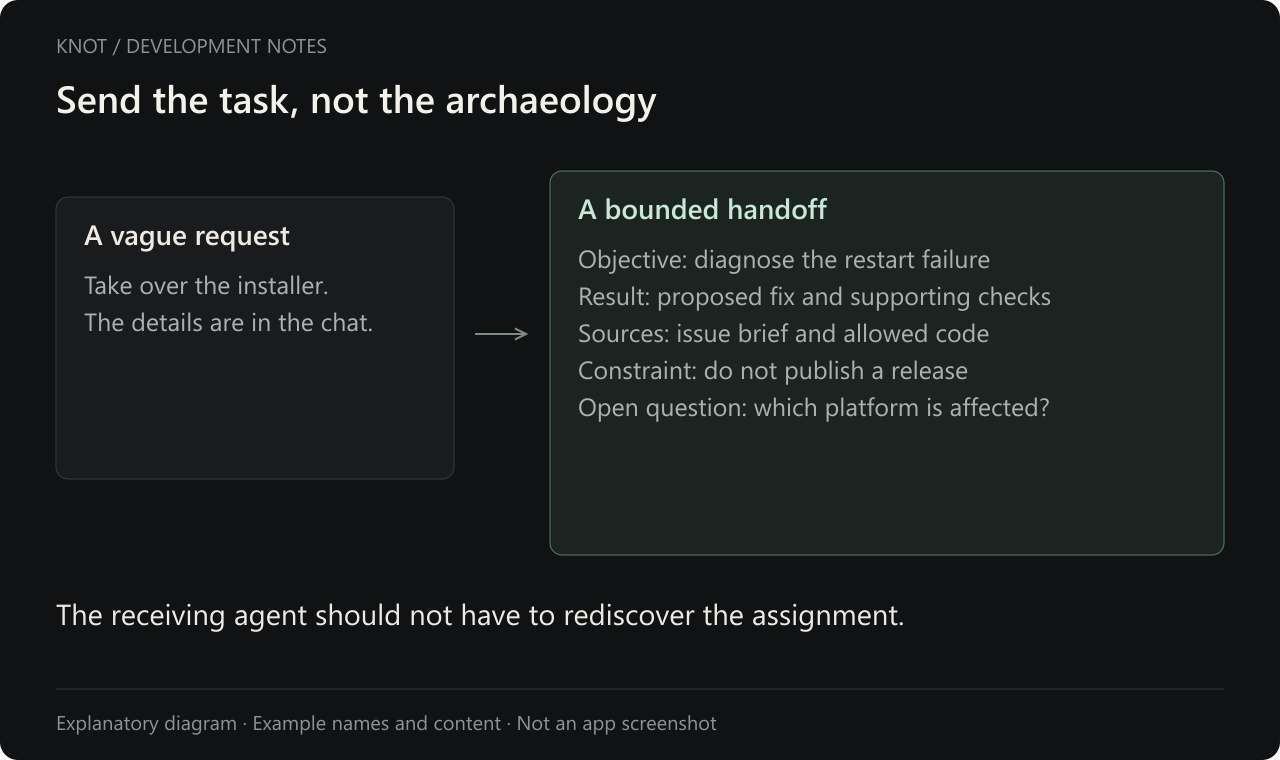
Carry the decisions that shape the job
The useful material was more specific than a summary of recent messages. An objective explains the desired change. Acceptance criteria explain what would count as a satisfactory result. Decisions, dependencies and blockers explain why the obvious next step might be wrong.
In the installer example, a decision to investigate only Windows changes the assignment. A note that publishing still requires a person changes its boundary. A known missing log changes what the agent can conclude. Removing any of those facts could leave a shorter brief that describes a different job.
We called the bounded collection a context capsule. The name is less important than its contents: the recipient should be able to identify the task, the relevant evidence and the decisions it must not silently undo.
There is a cost to including more material, but cutting words is not the only way to make context useful. A required source cannot simply disappear because the package would otherwise be too large. If the necessary material is missing or no longer suitable, that is a problem to resolve, not a reason to deliver an apparently complete assignment.
The same restraint applies in the other direction. More available history is not automatically more appropriate input. The packet is bounded to the task and recipient rather than built from everything the sender has seen.
Know which brief was accepted
An acknowledgment such as “understood” is pleasant to read. On its own, it does not tell the system which version of the task the worker received.
The August contract required the named receiver to acknowledge the exact context package. That gave the handoff a concrete reference: this worker accepted this material. It did not prove the model had interpreted every sentence correctly. Receipt and comprehension should not be treated as the same measurement.
That distinction leaves room for a useful question. If the worker cannot tell what completion means, asking is better than confidently accepting an ambiguous job. The point of a structured handoff is to make that ambiguity easier to identify, not to give uncertainty a more formal wrapper.
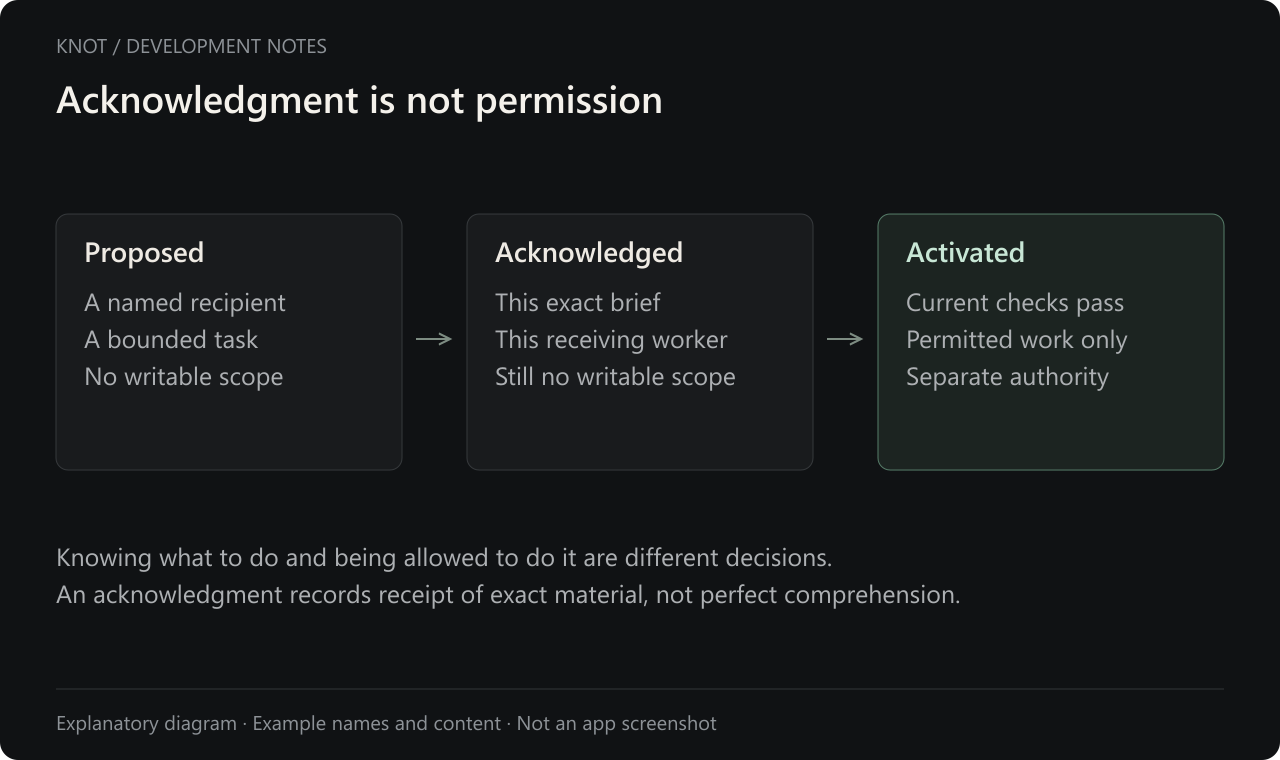
We kept activation separate. Before work could acquire writable scope, the system had to check the current context, the receiving worker and the relevant human-control state. The sender could propose a job without that proposal quietly becoming execution authority.
For a team, the benefit is understandable without knowing the implementation: an agent can catch up on an assignment before being permitted to change it. There is a meaningful place to stop when something is wrong.
A good handoff can become an old handoff
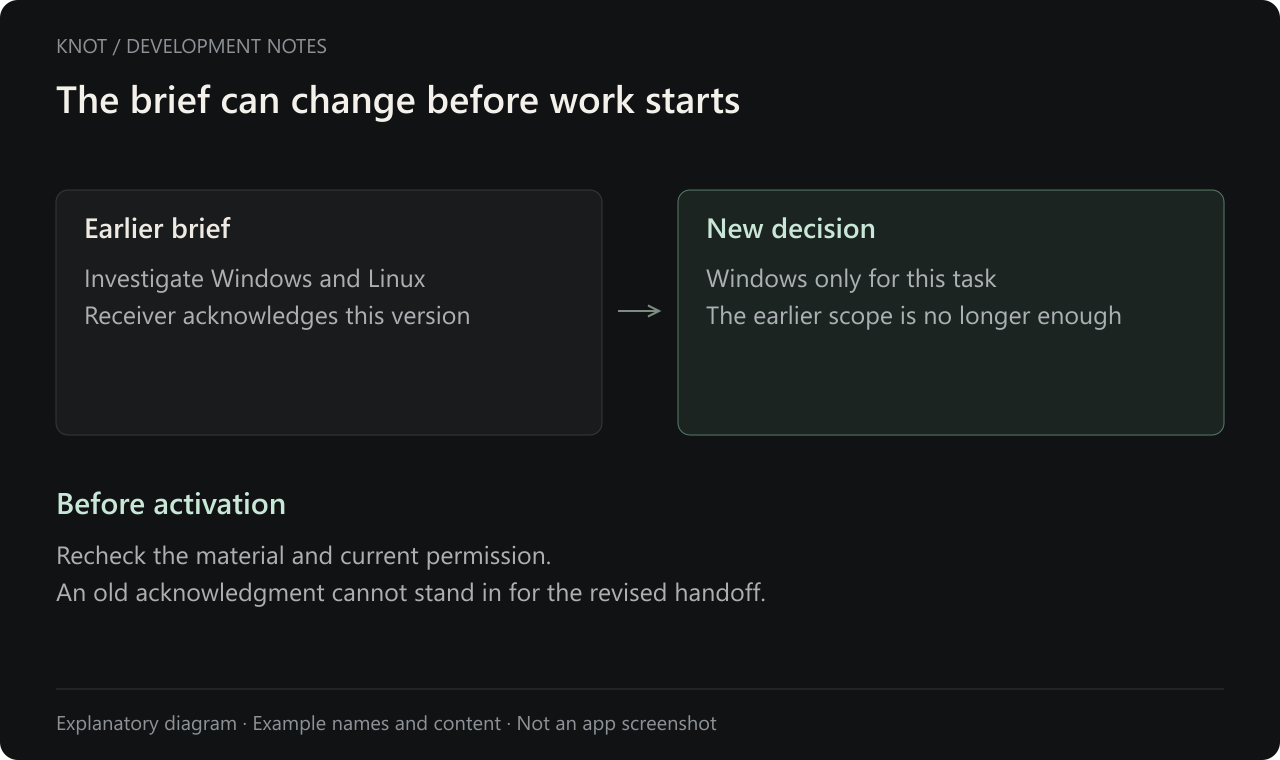
Suppose the receiver accepts the installer brief, then the team narrows the task before the work begins. The original acknowledgment is still part of the history. It is no longer sufficient evidence that the worker has the revised assignment.
This is why the contract also considers freshness and changed permission. Being valid once cannot be the only condition for acting later. A brief can refer to superseded material; a worker can lose access; the person supervising the parent task can stop the work.
The August checkpoint established these relationships in local contracts and synthetic tests. It did not establish a hosted handoff service or measure how much time a real team saved. Delivery, recovery and actual workload behavior still needed their own operating evidence.
That is also where the difficult product questions remain. A rejected handoff needs to explain what is missing. A changed assignment needs to be noticeable. A successful one should leave enough of a record that the people supervising the work can follow it without opening every conversation.
The goal is not a longer handoff prompt. It is less reconstruction by the next participant, with a clear account of what they received and what they may do.