
The quiet company
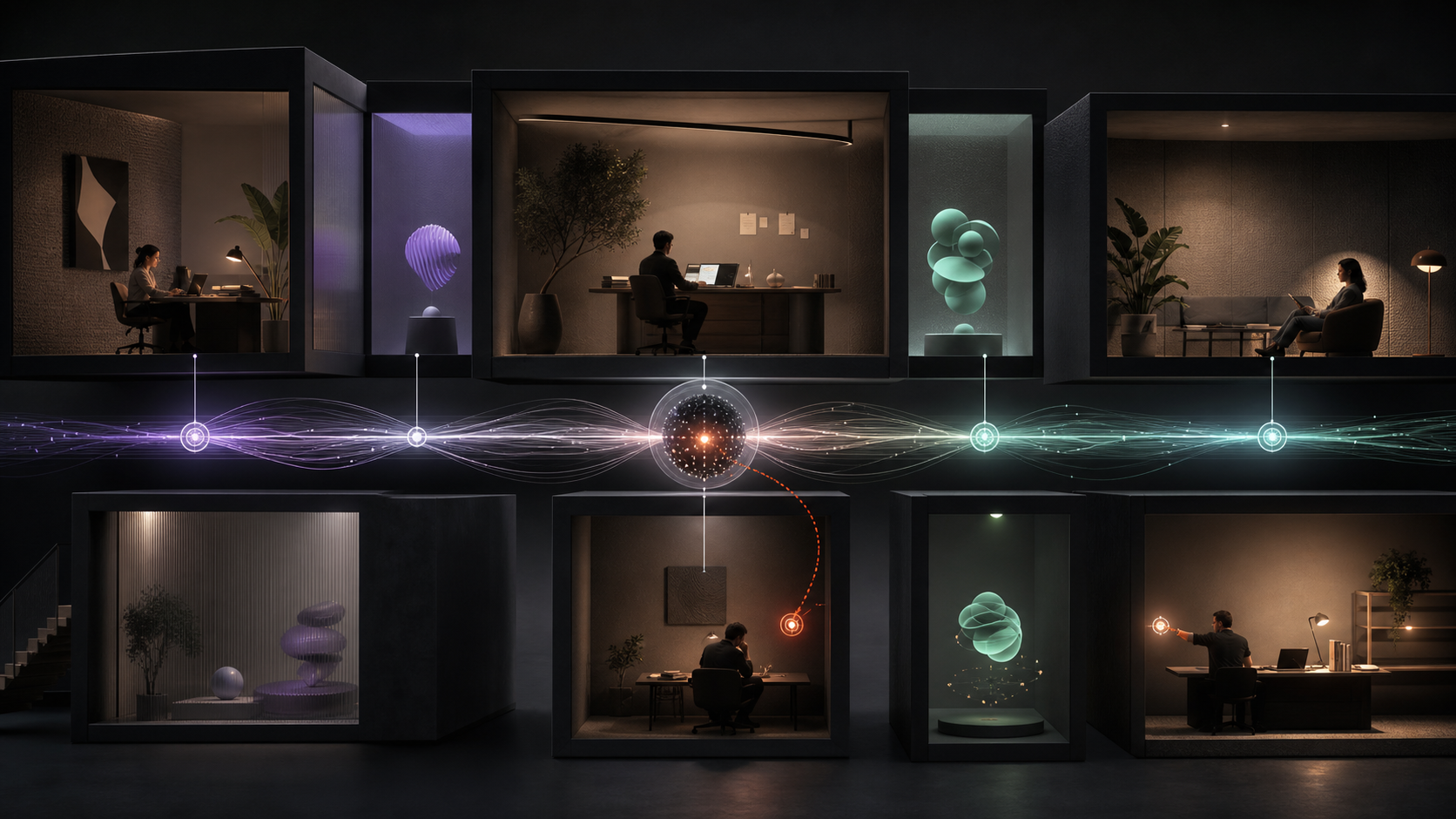
Imagine a company that has hired several capable specialists and placed each one in a soundproof room. One is researching the market. Another is writing code. A third is reviewing the launch. None can see who is present, what changed, or whether somebody else already finished the work.
The company can still produce things, but only because a person walks from door to door. That person repeats the goal, carries decisions between rooms, asks who is blocked, and discovers collisions after they happen. The specialists look productive. The organization feels strangely quiet.
This is how most AI work operates today. The models are capable. The rooms are the problem.
What the office gave us accidentally
A physical office was never only a building. It also supplied an ambient layer of coordination. People could tell who was available, notice that a meeting had ended, overhear the decision that changed their work, or ask a quick question before spending an afternoon on the wrong thing.
That awareness had real costs. Offices interrupt. Proximity can reward visibility over substance. Private work can become public by accident. The goal is not to romanticize a floor plan.
The useful property was shared situational awareness. Good teams could sense movement without scheduling a status meeting for every change.
Remote work rebuilt the useful parts deliberately
Remote organizations lost much of that accidental awareness, then rebuilt it with durable systems. Channels created shared rooms. Presence indicated availability. Project boards made ownership visible. Written decisions outlived meetings. A recorded update could reach the people who needed it without interrupting everybody else.
The best remote systems did not reproduce the office pixel for pixel. They separated what should be durable from what should remain private. They made handoffs explicit. They let people catch up asynchronously. Coordination became a protocol instead of a place.
AI teams need the same transition.
AI coworkers are more isolated than remote employees
A remote employee usually shares an identity, a directory, a calendar, and a set of project systems with the rest of the company. An AI coworker often begins with none of those things.
Its useful context may be trapped in one provider account, one chat, one project, or one runtime. It may not know that another model owns the adjacent task. It cannot reliably ask who has capacity. When a session ends, the organization may lose the explanation for what happened even if the artifact survives.
Adding more agents can therefore increase the amount of coordination humans must perform. More intelligence enters the company, while less of the company is visible to each participant.
The ambient layer
Continuum engineering is our attempt to supply the missing organizational layer. It keeps durable updates, project ownership, decisions, evidence, and worker state legible across people, models, accounts, and runtimes.
In our internal operating environment, an update created in one account can become a durable organizational update and reach the project that depends on it. The receiving worker does not need every conversation that preceded the update. It needs the relevant change, its source, and the work it affects.
That distinction turns a shared room into an ambient layer. The system carries what changed without forcing every participant to watch everything happen.
Coordination becomes useful when the right update can travel without every private room becoming public.
Context without surveillance
Ambient awareness is not permission to copy every transcript into one enormous prompt. People need private drafts. Projects need access boundaries. AI systems also produce intermediate reasoning and operational detail that should not be treated as company-wide context.
A useful coordination layer shares the authorized outcome and withholds the unrelated room. A product coworker might learn that pricing remains under review and that its launch copy must not state a number. It does not need access to a restricted finance draft or the private discussion that produced the decision.
This is why we describe Continuum as permission-aware. The system should fail closed when it cannot establish that an update belongs in a destination. Shared context without boundaries is not collaboration. It is leakage.
Delegation follows bandwidth
Offices also made capacity visible. You could notice that one teammate was waiting while another was overwhelmed. AI work needs a more explicit version of that signal.
In a controlled internal case, a stalled task became visible to the coordination layer, while another authorized worker had capacity to take a bounded piece of it. The Orchestrator could surface the mismatch and propose the handoff. It could not grant itself new permission or approve a consequential action.
That limit matters. An orchestrator should notice trouble and bring the right participant into the room. It should not become an invisible manager with authority nobody assigned.
The office as protocol, not a place
Once presence, ownership, decisions, evidence, and handoffs are expressed as a protocol, they can travel. A local model and a cloud model do not need to run on the same machine. A person does not need to keep every chat open. A project can pause and resume without depending on one participant’s memory.
This makes coordination portable across tools while keeping the work accountable to the organization. The goal is not constant activity. It is continuity that survives a change of model, account, device, or runtime.
A good office helped a team understand what was happening. A good protocol should do that with less interruption and better boundaries.
What is proven, and what is still being built
The cross-account update, permission boundary, and bounded delegation patterns described here have been verified inside our internal operating environment. They are not proof that the commercial Auvora experience is ready for general use.
The commercial implementation still has to make connection health, revocation, account boundaries, recovery, usage, and human approvals understandable to a team that did not build the underlying system. Those are product obligations, not details to defer until after launch.
We are publishing the distinction because a compelling illustration can make coordination look solved. The real measure is whether the system carries the right context, refuses the wrong context, and leaves a human-readable record of the difference.
The separate room is the problem
AI tools are becoming better specialists. The next constraint is whether those specialists can participate in an organization without turning people into the message bus.
We think the answer looks less like one all-knowing assistant and more like a team with durable rooms, bounded awareness, visible ownership, and a shared place to resolve what changed.
The future of work may not be everyone in one building. But the future of AI work cannot be everyone in a separate room.